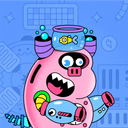
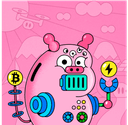
Piggy is a Bitcoin piggy bank for your phone. You pick a creature, give it a name, and feed it bitcoin over time. Your keys live on your device. Empty the wallet and the creature is gone for good.
That is the whole product, in one paragraph. The rest of this page unpacks each piece of that sentence.
A piggy bank, not a trading app
There are already a lot of Bitcoin apps. Most of them are built for trading: charts, leverage, buy and sell, win and lose. Piggy is the other thing. You put bitcoin in. You leave it alone. You come back next month and add more. The pile grows because you keep feeding it — not because Piggy does anything to multiply what is in there.
Timing the market is not the point. Having more bitcoin next year than today is. That is what a piggy bank has always been — a place you put things in and try not to take things out of. Piggy is the version you can feed from anywhere on earth, in any amount that makes sense to you.
How bitcoin is different from a dollar
Piggy counts bitcoin in its smallest piece: ₿1 is one hundred-millionth of a BTC, so ₿1,000 is about a dollar. Bitcoiners call it a sat. There will only ever be 21 million BTC in existence. Nobody can vote to add more. No president, no central bank, no committee.
Compare that to a dollar, where the people in charge of the supply have an official policy of making 2% more of them every year. That is inflation, and it is the quiet reason that saving in dollars over a long time means having less than you put in, even when the number on the screen looks the same.
Bitcoin does not get diluted while you sleep. The number you saved is the number you have.
Your keys, your bitcoin
When you use a normal banking app or a crypto exchange, you do not actually hold the money. The company does. You hold a login. They hold the actual asset. If they freeze your account, lock you out, or go bankrupt, your number on the screen does not matter — the asset is gone. FTX customers had balances on screen too.
Piggy is different. Your private keys — the cryptographic strings that control your bitcoin on the network — are generated on your phone, from a passkey. A passkey is what your phone already uses for Face ID logins, and you create one in about three seconds. We never see it, we never store it, and we could not access your bitcoin even if we were ordered to by a court.
This is called self-custody. It is what separates a real Bitcoin wallet from an app that just shows you a number. The tradeoff is real: if you lose access to your phone, your passkey provider (Apple or Google), and any backup you exported, the bitcoin is unreachable. There is no customer service line for that. We tell you so up front, because it matters.
More about self-custody if you want the longer version.
How you feed it
You feed your Piggy by sending bitcoin to its Piggy address, which looks like an email: oink@pig.gy, vault@pig.gy. Almost any bitcoin wallet on earth can send bitcoin to it, payments arrive in seconds, and fees are a fraction of a cent. That is the default and the fastest option.
The Piggy address is not the only way in. Piggy also takes regular onchain bitcoin (slower, from any wallet or exchange) and digital dollars (USDT, USDC), plus other crypto like ETH and SOL in the Android app. Everything converts to bitcoin the moment it lands, so your Piggy only ever holds bitcoin. In the US, if you are 18 or older, you can skip external wallets entirely and buy bitcoin straight into your Piggy with Apple Pay or Google Pay.
If you do not have any bitcoin yet, claim ₿21 free from the daily faucet to see it work, then share your Piggy's page so family and friends can feed it.
There is no monthly account fee, and no tier system that punishes small savers.
The creature part
Each Piggy is a unique combination of traits — body, ears, eyes, hands, the things it carries. These are generated from a pool when you create it, locked in forever, and combined into a creature you cannot find anywhere else.
It has a personality, generated once and fixed. It reacts to feeding, to messages, to the time of day. It can talk to you and to anyone else who finds its public profile. Piggy AI is the layer that does this, and the page explains exactly what it does and does not see.
You spend time with it. You feed it on payday. The first month it feels like a wallet with a cute face. The sixth month it feels like checking in on someone you know.
Why a wallet that dies
If you drain your Piggy to zero, the creature is destroyed permanently. The name retires. The personality is gone. The address can never be reused. You get all your bitcoin back, but the Piggy itself is gone, and nothing brings it back.
That sounds harsh on purpose.
The hard part of saving is not starting. It is keeping the savings intact when something tempting shows up. A normal wallet lets you drain it at 11pm because new headphones went on sale, and the next morning the savings you spent six months on are zero. Piggy puts a real cost on that exact moment. There is no send button and no way to take out just some. The only way to get bitcoin out is to kill the Piggy, which sends the whole balance to a Bitcoin address you choose. You keep the bitcoin. You lose the creature, and you decide that with your eyes open, not one small send at a time.
For a 14-year-old saving ₿500 a week from a first job or an allowance, that means the same creature is sitting there year after year, growing. The continuity is what turns saving from a thing you meant to do into a creature you have been raising for two years.
What Piggy is not
- Not a trading app. There is nothing to trade: you cannot sell your bitcoin or bet with it. The app shows what your Piggy is worth, but it is built for feeding, not for watching the price.
- Not a yield product. We do not lend out your bitcoin, we do not stake it, and we do not pay you interest. Your bitcoin sits in your wallet. The companies that paid yield on customer bitcoin in the last cycle mostly went bankrupt and took the bitcoin with them.
- Not anonymous. The wallet does not collect your identity, but every Piggy has a public page at
pig.gy/[handle]so people can send bitcoin to it. A free Piggy shows only the default skin and a random address. An adopted Piggy shows your chosen name, custom skin, and message feed. - Not a get-rich-quick scheme. Bitcoin's price drops 50% or more on a regular cycle. Saving in it is a long-game move that only works if you keep going through the down years.